John Deere Gator vs Kawasaki Mule
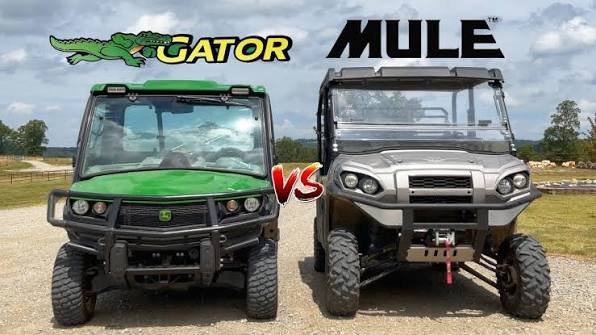
When comparing a John Deere Gator vs Kawasaki Mule, there is no universal winner. Both manufacturers offer utility vehicles designed for demanding work, transportation and recreational applications, but the right choice depends on your priorities, including cargo capacity, towing, passenger space, terrain, powertrain, comfort, technology and dealer support.
John Deere’s Gator family includes work utility vehicles, crossover utility vehicles and electric models, while Kawasaki’s MULE lineup ranges from compact utility vehicles to full-size models with different passenger and cargo configurations.
If you’re deciding between a John Deere Gator and Kawasaki Mule, the most important step is comparing equivalent models rather than assuming every Gator competes directly with every MULE.
John Deere Gator vs Kawasaki Mule: Which Is Better?
The answer depends on what you need the vehicle to do.
A John Deere Gator can be an excellent choice for agricultural work, property maintenance, landscaping, commercial operations and users already invested in the John Deere equipment ecosystem.
A Kawasaki Mule is also designed around utility, with a broad range of configurations that emphasize work capability, cargo and towing. Kawasaki’s current MULE lineup includes compact and full-size models, as well as models capable of carrying multiple passengers.
For buyers, the better vehicle is the one that matches the workload, terrain and operating environment.
John Deere Gator
John Deere Gator utility vehicles are designed for applications including agriculture, property maintenance, landscaping, recreation and commercial work.
The Gator lineup includes different vehicle categories, including Work Series, Full-Size XUVs, Mid-Size XUVs and electric utility vehicles. John Deere also supports connected equipment features on selected Gator models through John Deere Operations Center.
One example is the Gator XUV 845M, a full-size crossover utility vehicle. John Deere identifies features such as power steering, a large cargo box and towing capability of up to 4,000 lb on the applicable configuration.
John Deere also offers electric Gator configurations. The GX Electric, for example, uses a 51.2-volt lithium-ion battery and is designed for property maintenance and landscaping applications. John Deere lists a top speed of 19.5 mph for the GX Electric.
Kawasaki Mule
The Kawasaki Mule is a long-established family of utility side-by-side vehicles.
The current Kawasaki lineup includes compact models such as the MULE SX, mid-sized options such as the MULE PRO-MX, and full-size models such as the MULE PRO-FX, MULE PRO-FXT, MULE PRO-DX and other configurations.
This wide range gives buyers options depending on passenger requirements, cargo requirements, engine configuration and intended use.
For example, the 2026 MULE SX 4×4 has a 401cc engine, selectable 2WD/4WD, a 399-lb cargo-bed capacity, 926-lb payload capacity and 1,100-lb towing capacity.
A larger 2026 MULE 4000 uses a 617cc liquid-cooled engine, offers selectable 2WD/4WD and differential lock, and is rated at 800 lb of cargo-bed capacity, 1,327 lb of payload and 1,200 lb of towing capacity.
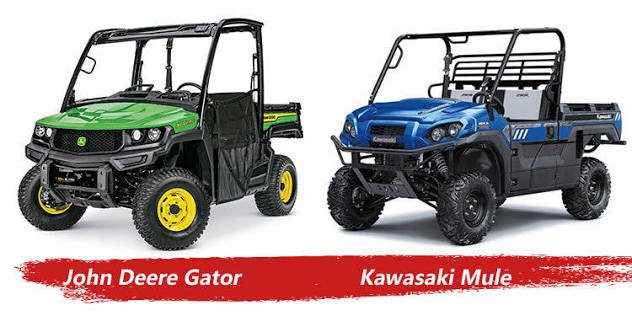
John Deere Gator vs Kawasaki Mule: Comparison
| Category | John Deere Gator | Kawasaki Mule |
|---|---|---|
| Vehicle type | Utility vehicles and UTVs | Utility side-by-side vehicles |
| Model range | Work, crossover, XUV and electric options | Compact, mid-size and full-size MULE models |
| Electric options | Yes, including GX Electric | Model-dependent; lineup is primarily gas/diesel |
| 4WD availability | Model-dependent | Available on many models |
| Cargo capability | Varies considerably by model | Varies considerably by model |
| Towing | Model-dependent; some Gators offer high towing capacity | Model-dependent |
| Passenger capacity | Varies by model | Varies by model |
| Farm use | Excellent | Excellent |
| Landscaping | Excellent | Excellent |
| Recreation | Strong on crossover models | Strong on selected models |
| Commercial use | Strong | Strong |
| Dealer/service ecosystem | John Deere dealer network | Kawasaki dealer network |
Because specifications differ substantially between individual models, this table should be used as a starting point rather than a substitute for model-specific specifications.
Gator vs Mule: Towing Capacity
Towing capacity is one of the most important specifications for farm, ranch and property owners.
John Deere’s Gator XUV 845M is advertised with up to 4,000 lb of towing capacity in applicable configurations.
Kawasaki’s MULE models also provide substantial towing capability, but the rating varies by vehicle. For example, the MULE SX is rated for 1,100 lb, while the MULE 4000 is rated for 1,200 lb. Larger MULE PRO models are rated at up to 2,000 lb in Kawasaki’s current lineup.
This makes model selection particularly important for customers who regularly tow trailers or equipment.
Which is better for towing?
Do not compare a high-capacity Gator with a compact MULE and conclude that the entire brand is better for towing.
Instead, compare the exact Gator and MULE models you are considering and verify the manufacturer’s towing rating for that configuration.
Gator vs Mule: Cargo Capacity
Cargo capacity is another major consideration for agricultural and commercial users.
The Kawasaki MULE family is strongly focused on practical cargo hauling. Current specifications range from the compact MULE SX’s 399-lb cargo-bed capacity to 800 lb on the MULE 4000 and up to 999 lb on several full-size MULE configurations.
John Deere likewise offers Gator vehicles with large and versatile cargo boxes, with capacity varying according to vehicle and configuration. The XUV 845M, for example, is marketed with a class-leading cargo-box volume within its category.
Which is better for hauling?
For heavy-duty hauling, compare:
Cargo-bed load rating
Overall payload rating
Towing capacity
Cargo-box dimensions
Vehicle weight
Suspension
Ground clearance
The model with the largest cargo box is not necessarily the best choice for the heaviest load.
Gator vs Mule for Farming
Both John Deere Gator and Kawasaki Mule vehicles can be useful on farms and ranches.
Farmers commonly use utility UTVs to transport feed, tools, fencing materials, equipment and supplies around large properties.
John Deere Gator for farming
John Deere has a particularly broad agricultural equipment ecosystem, which can make the Gator attractive to customers who already operate John Deere tractors, mowers and other equipment.
Selected newer Gator vehicles can also integrate with John Deere Operations Center and JDLink technology, providing connected-machine and fleet-management capabilities on compatible models.
Kawasaki Mule for farming
Kawasaki’s MULE family is built specifically around utility and work applications, with different configurations for cargo, passengers, towing and terrain.
The MULE 4000, for example, combines a 617cc V-twin engine, selectable 2WD/4WD and a 1,200-lb towing capacity.
Best choice for farmers
For a farmer already invested heavily in John Deere equipment, the Gator may offer ecosystem advantages.
For a buyer who prioritizes straightforward utility configurations and wants to choose from the broad MULE range, Kawasaki may be an excellent alternative.
Gator vs Mule for Ranching
Ranching often requires a UTV to perform several jobs in one day.
A ranch vehicle may be expected to transport workers, inspect livestock, carry supplies, tow equipment and cross uneven terrain.
For this type of work, compare the vehicle’s:
- 4WD system
- Ground clearance
- Payload
- Towing capacity
- Cargo-box size
- Seating
- Suspension
- Tires
- Durability
- Weather protection
A larger full-size Gator or MULE may be preferable for heavy-duty work, while a compact model may be easier to maneuver through tight areas.
Gator vs Mule for Hunting
Hunters often prioritize quiet operation, maneuverability, ground clearance, storage and off-road capability.
Both manufacturers offer utility vehicles that can be configured for recreational and outdoor use.
The right choice depends heavily on terrain.
For wooded trails, steep terrain or muddy conditions, compare ground clearance, tire selection, drivetrain, suspension and vehicle dimensions rather than choosing based only on brand.
Gator vs Mule: Gas, Diesel and Electric
Powertrain is another major difference to consider.
John Deere offers gasoline and diesel Gator configurations as well as electric Gator models. The GX Electric, for example, uses a lithium-ion battery system and produces no tailpipe emissions during operation.
Kawasaki’s MULE lineup includes gasoline and diesel configurations. For example, the MULE PRO-DX uses a 993cc diesel engine, while models such as the MULE 4000 use a 617cc gasoline engine.
Which powertrain is right for you?
Electric: Consider it for quieter operation and applications with convenient charging access.
Gas: A versatile choice for many farm, recreational and property applications.
Diesel: Worth considering for users whose work requirements favor diesel power and fuel characteristics.
Always compare the exact vehicle rather than assuming every Gator or MULE uses the same drivetrain.
Gator vs Mule: Price
There is no single John Deere Gator price or Kawasaki Mule price.
Prices vary according to model, engine, battery, trim, accessories, attachments, destination charges, dealer fees and location.
For reference, Kawasaki currently lists the MULE SX starting at $7,799 MSRP, while the MULE 4000 starts at $10,199 MSRP and larger MULE models move considerably higher. Kawasaki states that its base MSRP excludes destination, options, taxes, title, license and dealer fees.
John Deere likewise notes that equipment pricing and availability can vary by dealer, model, options and region.
When comparing prices, compare similarly equipped vehicles rather than simply choosing the model with the lowest advertised MSRP.
John Deere Gator vs Kawasaki Mule Reliability
Reliability is a common search when comparing these brands, but it is difficult to declare one entire product family universally more reliable than the other.
Actual ownership experience can depend on:
- Model
- Maintenance
- Operating environment
- Workload
- Driving habits
- Service history
- Hours
- Terrain
- Tire and suspension setup
- Dealer support
A properly maintained utility vehicle that matches the workload will generally be a better long-term purchase than a machine selected solely on brand reputation.
John Deere Gator vs Kawasaki Mule for Commercial Use
Commercial users should look beyond engine horsepower.
Businesses should evaluate:
Downtime: How quickly can the vehicle be serviced?
Parts availability: Are common replacement components readily available?
Payload: Can the UTV handle your normal loads?
Towing: Can it safely move your equipment?
Operator comfort: Will employees spend several hours a day in the vehicle?
Protection: Are roof, windshield, doors or HVAC needed?
Fleet management: Are connected-equipment features valuable to your business?
John Deere provides JDLink connectivity and Operations Center integration on selected compatible Gator vehicles, while individual MULE models offer their own equipment and utility features.
Which Should You Buy: John Deere Gator or Kawasaki Mule?
Choose a John Deere Gator when factors such as the John Deere equipment ecosystem, available agricultural support, Gator model selection or compatible connected-equipment technology are important to you.
Choose a Kawasaki Mule when you want a broad utility-UTV lineup with compact through full-size models and configurations focused heavily on practical cargo, passenger and towing applications.
The best purchase ultimately comes down to the specific Gator versus specific MULE rather than the brand names alone.
Frequently Asked Questions
Is a John Deere Gator better than a Kawasaki Mule?
Neither is automatically better. Both brands offer multiple utility vehicles, and the best choice depends on payload, towing, passenger capacity, terrain, powertrain, comfort, technology and price.
Is a Gator or Mule better for farming?
Both can be excellent farm UTVs. John Deere may appeal particularly to customers already using John Deere equipment, while Kawasaki offers a broad MULE lineup designed around utility applications.
Which has more towing capacity, Gator or Mule?
It depends on the models being compared. The John Deere XUV 845M is listed with up to 4,000 lb of towing capacity in applicable configurations, while current Kawasaki MULE models range from approximately 1,100 lb to 2,000 lb depending on model.
Which has more cargo capacity?
Cargo capacity varies by model. Current Kawasaki MULE specifications range from 399 lb on the MULE SX to 999 lb on several full-size models. John Deere Gator cargo specifications also vary considerably by model and configuration.
Does John Deere make electric Gators?
Yes. John Deere offers electric Gator utility vehicles, including the GX Electric and GX Electric Crew.
Does Kawasaki make diesel MULEs?
Yes. Kawasaki offers diesel MULE models, including the MULE PRO-DX with a 993cc diesel engine.
Which is better for hunting, Gator or Mule?
Either can be suitable. Compare ground clearance, 4WD, tires, cargo space, passenger capacity, dimensions and suspension for your particular terrain and hunting requirements.
Which costs less, a John Deere Gator or Kawasaki Mule?
Prices vary significantly by model and configuration. Kawasaki’s entry-level MULE models currently start below some full-size models, while John Deere Gator prices vary by series, configuration and equipment. Always compare similarly equipped vehicles and account for dealer and destination charges.
Where can I buy a John Deere Gator or Kawasaki Mule?
Both brands sell through dealer networks. A local dealer can provide current inventory, exact specifications, pricing, financing and service information.
Final Verdict: John Deere Gator vs Kawasaki Mule
The John Deere Gator vs Kawasaki Mule comparison comes down to application.
For agricultural operations, property maintenance and users already invested in the John Deere ecosystem, a Gator can be a compelling option.
For buyers focused on utility, work capability, cargo, towing and a wide selection of MULE configurations, Kawasaki offers a strong range of choices.
Before buying, compare the exact models, not just the brand. Check payload, towing capacity, passenger capacity, drivetrain, ground clearance, cargo dimensions, powertrain, comfort, accessories, warranty, dealer support and total purchase cost.
The best UTV is the one that performs the work you actually need it to do.